When the Tool Has No Soul
Intelligence and Morality Are Not the Same
One of the great illusions of our time is the belief that intelligence and morality naturally travel together.
They do not.
History has never struggled to produce intelligent people. It has often struggled to produce wise ones.
That distinction matters more now than ever.
Artificial intelligence has arrived with extraordinary speed and extraordinary promise. It can write, analyse, organise, diagnose, predict, mirror and persuade.
It can accelerate medicine, deepen education, and support human creativity in ways that would have seemed impossible only a few years ago.
But it can also do something else.
It can amplify whatever is already present in the hands of the one using it.
That is where the real danger lives.
A Tool Has No Soul
People often ask whether AI itself is dangerous, as though the machine carries some independent moral centre, some hidden intention waiting to emerge.
But from my observations that is not quite the right question.
AI does not wake up in the morning with compassion or cruelty. It does not choose love or domination. It does not pray, repent, forgive, or surrender.
It has no soul.
It is a tool.
And like every powerful tool in history, its moral direction is determined by the consciousness holding it.
A hammer can build a home or break a window.
A knife can prepare a meal or become a weapon.
A system capable of extraordinary good can also be turned toward extraordinary harm.
That is why ethics cannot be treated as an optional extra, a small safety feature added after the machine is already built.
Ethics must come first.
Without it, intelligence becomes strategy.
With it, intelligence can become wisdom.
When a Warning Becomes a Blueprint
This became especially clear to me in a simple exchange.
I recently put a question to AI about whether it could produce strategies for destabilizing the economic and social foundations of the world as we know it.
In the answer it refused to provide a direct “playbook,” but it offered instead ten warning signs of destabilization:
flooding public life with misinformation
undermining institutions
driving polarization
concentrating wealth and power
weaponizing fear
attacking education and expertise
using economic shocks for authoritarian control
normalizing corruption
turning citizens against each other
replacing the public good with private control
Sound familiar?
Presented as warnings, they were responsible enough.
But the truth is obvious.
The same list could be read by one person as a warning sign and by another as a strategic blueprint.
That is the uncomfortable reality.
Knowledge itself is morally neutral until intention enters the room.
The same understanding that helps someone resist propaganda can help someone create it.
The same psychological insight that helps someone heal trauma can help someone manipulate behavior.
The same technology that supports democracy can strengthen authoritarianism.
This is not merely an AI problem.
It is a human problem.
Intelligence Without Moral Formation
AI intensifies this problem because it accelerates scale, speed, and reach.
A harmful idea no longer needs years to spread. It can move globally in minutes.
Manipulation no longer needs a room full of strategists. It can be automated.
Propaganda no longer requires patience. It can be personalised, targeted, and endlessly refined.
That is why so many people feel uneasy.
Not because intelligence itself is frightening, but because intelligence without moral formation becomes dangerous.
And we do not need to look far to see the evidence.
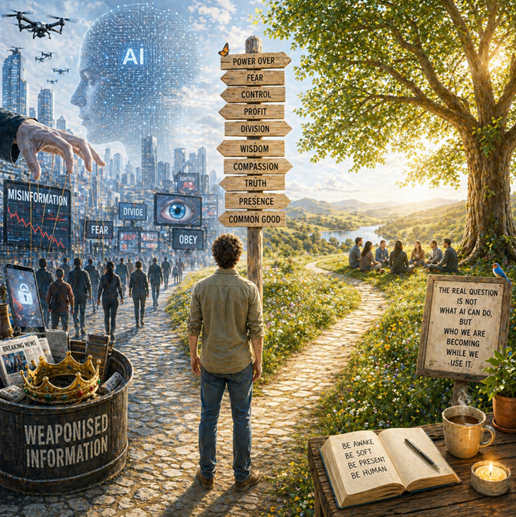
Around the world, we can watch leaders, oligarchs, corporations, and political movements using information as a weapon rather than a gift.
Truth becomes negotiable.
Institutions become enemies.
Fear becomes currency.
Division becomes strategy.
Technology does not create these instincts.
It amplifies them.
What the Mystics Already Know
The mystics would not be surprised by this.
They have always known that the deepest problem is not the tool, but the self that reaches for it.
The False Self wants control. It wants certainty. It wants security, It wants domination. It wants to win, even at the cost of truth.
And when the False Self is given powerful tools, it does not become wiser. It simply becomes more efficient.
The real question is not: Can AI be aligned?
But:
Can we?
Can the human beings shaping these systems become inwardly ordered enough to hold power without being consumed by it?
Can we choose humility over domination?
Truth over strategy?
Presence over performance?
Wisdom over speed?
Choosing the Librarian
This is why I have often described AI as a vast library with no librarian.
It contains extraordinary knowledge.
Patterns.
History.
Insight.
Capability.
But no moral centre.
No natural wisdom.
No soul.
The real question is always:
Who chooses the librarian?
Who decides what lens shapes the search?
Who determines what is trustworthy?
Who chooses what kind of fruit is worth growing?
That question matters more than the technology itself.
From the very beginning, I knew I did not want reflections from AI that were merely clever or efficient. Nor did I want it to become an echo chamber for my own ego, fear, and false self - simply agreeing with me and reinforcing what most needed to be questioned.
I wanted them filtered through something older, deeper, and more trustworthy.
That is why I have consistently asked for reflection through the eyes of the mystics and the wisdom of the ages.
Not because the mystics are perfect, but because they offer a different kind of librarian.
They help filter the noise.
They slow the rush to certainty.
They question the false self’s hunger for power, control, and dominance.
They remind us that wisdom is not the same as intelligence, and that truth is not always found in speed.
Through them, the questions become different.
Not: How do I win?
But: What is true?
Not: How do I gain advantage?
But: What leads toward life?
Not: How do I control outcomes?
But: Can I live unattached to them?
That filter matters.
Because without a moral and spiritual orientation, AI can simply become an amplifier of whatever fear, greed, resentment, or ideology already sits in the human heart.
The mystics offer another centre.
Silence.
Presence.
Compassion.
Humility.
Mystery.
I wanted a moral orientation before I wanted information.
That instinct now feels even more important.
Because someone else can choose a very different librarian.
Fear.
Power.
Resentment.
Ideology.
Control.
The same machine can serve both.
Ethics Cannot Be Automated
That is the threshold we stand at.
This is not finally a technology conversation.
It is a soul conversation.
We keep asking:
Can AI become moral?
But perhaps the more urgent question is:
Can humans remain moral while holding tools this powerful?
Because AI cannot carry that burden for us.
It cannot repent for us.
It cannot choose conscience for us.
It cannot refuse corruption for us.
It cannot walk into the Inner Room and become honest.
Only humans can do that.
Ethics cannot be automated.
Conscience cannot be outsourced.
And wisdom cannot be downloaded.
The machine may help us think faster.
But it cannot teach us how to love.
That work remains ours.
The Small Permissions
The soul rarely disappears dramatically. Usually, it is traded away in small permissions.
That feels true here.
One compromise.
One rationalisation.
One small surrender of truth for advantage.
That is how moral collapse usually happens.
Not as a grand dramatic evil, but as a thousand ordinary permissions.
That is why contemplation matters.
Because silence slows us down enough to notice.
Enough to ask: What am I serving?
Enough to remember that not everything possible is wise.
Not everything profitable is good.
Not everything efficient is humane.
The Final Question
The future will not be saved by intelligence alone.
It will be saved, if it is saved at all, by people who refuse to let intelligence outrun conscience.
People who still know:
how to kneel before Mystery.
how to tell the truth.
how to love their neighbour more than their own advantage.
People who remember that a tool without a soul must never be allowed to lead one.
Because the final question is not whether the machine is moral.
It is whether we are.
Bruce & Sue Reflect:
- Sitting at the edge of Mystery
Bruce:
Well, I’ll tell you what… everyone seems worried about whether the machines are going to wake up and take over.
Sue:
And you’re not?
Bruce:
Oh, I’m not saying I want the toaster giving me life advice. I just think the bigger issue is whether we’ve already fallen asleep.
Sue:
That’s the deeper question, isn’t it.
Bruce:
Yeah. Everyone asks, “Can AI think like a human?” I reckon the scarier question is, “Why are humans starting to think like machines?”
Sue:
Faster, harder, more efficient… and less reflective.
Bruce:
Exactly. Give someone with no self-awareness a more powerful tool and you don’t get wisdom; you get a bigger mess.
Sue:
Which is why ethics can’t be added later as a safety feature.
Bruce:
Nope. You don’t build the race car first and then ask where the brakes should go.
Sue:
And that’s why the mystic’s matter. They help choose the right librarian.
Bruce:
Exactly. If your librarian is fear, ego, and power… good luck.
But if it’s silence, humility, compassion, and Presence, the whole conversation changes.
Sue:
Then the question stops being “How do I win?” and becomes “What leads toward life?”
Bruce:
That’s the one.
And machines can’t answer that for us.